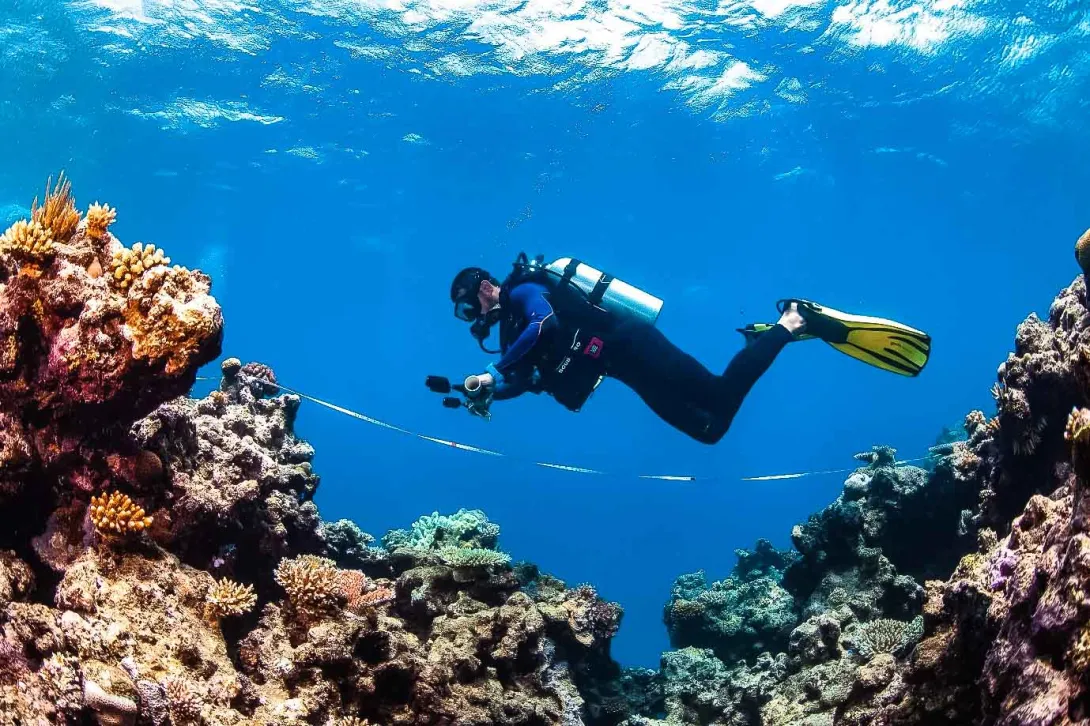
The Reef Authority has a long history of working collaboratively with science and knowledge providers and basing our management on the best available science.
Every few years we reflect on our knowledge needs, particularly following our five yearly Outlook Report, and identify priority knowledge needs.
Scientific information is a critical part of evidence-based decision making and reporting. An increasing knowledge base about the Great Barrier Reef is supported by a wide range of science and knowledge providers including research institutions, government agencies, Traditional Owners, innovators, industry partners and the Reef community.
Our Science Strategy
The Reef Authority’s Science Strategy outlines a clear pathway for identifying priority knowledge needs, helping to guide investment and focus science efforts towards evidence-based management of the Great Barrier Reef.
It also establishes a coordinated, impact- focused approach for translating research into management actions.
- Our 27 priority knowledge needs span four key themes which reflect our adaptive management cycle:
- PLAN for an uncertain future
- INTEGRATE multiple lines of evidence
- MONITOR the resilience of values and threats
- EVALUATE our management actions
Delivering the Science Strategy is a shared endeavour.
We invite funders, researchers, Traditional Owners, government agencies, innovators and industry partners to work with us.
To explore our Science Strategy, priority knowledge needs and collaboration guidelines in more details, visit our interactive Science Strategy webpage within the Reef Knowledge System.
How we use scientific knowledge
Obtaining robust information that addresses priority needs will support evidence-based reporting, enable ecologically sustainable use, increase the capability and effectiveness of our management responses, and better protect the Reef for future generations.
- Specifically, we use science and knowledge to support:
- designing decision support systems and tools
- identifying emerging risks to the Reef
- setting and monitoring triggers for management intervention
- developing policies, planning and management strategies
- providing expert advice to government and stakeholders
- making decisions (for example permits and environmental impact assessments)
- adaptive management and incident response
- developing community partnerships based on shared understanding
- preparing the Outlook Report.
For more information, contact our science team at science@gbrmpa.gov.au.