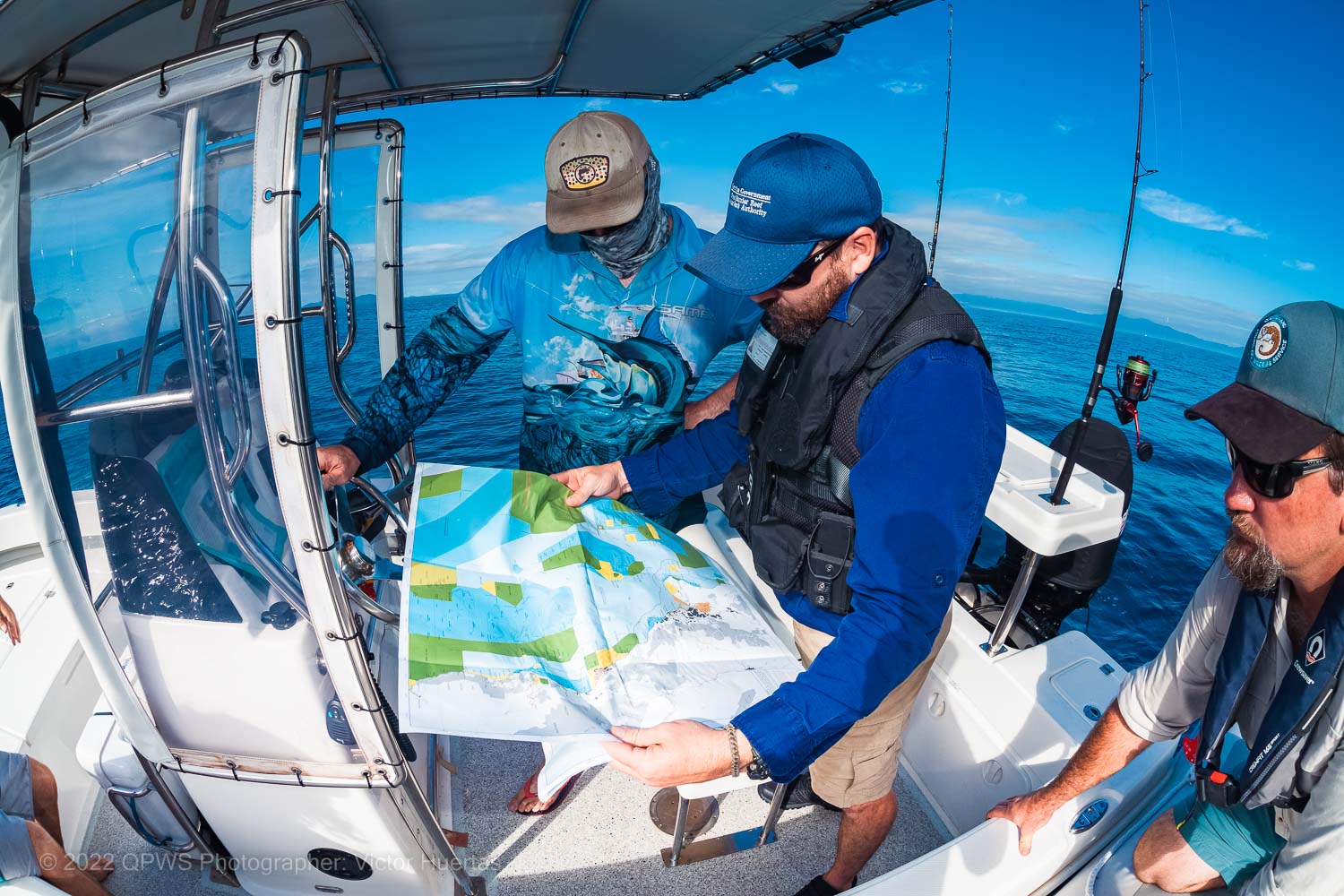
When enjoying the many different activities and experiences on the Great Barrier Reef, it is important to enjoy them in a responsible and 'reef friendly' way.
This can easily be done by following the Responsible Reef Practices for recreational users associated with each of these activities:
To help manage the Reef and even save marine life, please let the Great Barrier Reef Marine Park Authority know if you see any interesting and unusual things in the Marine Park. You can report these sightings through the Sightings Network.
On the water
Few wildlife experiences could compare to seeing a massive whale majestically rising out of the water and flopping backwards or a pod of dolphins playfully showing off their acrobatic skills.
One of the most commonly sighted whales is the massive humpback, which makes the trek to the Reef's warmer waters from Antarctica between May and September to court, mate, give birth or rear their calves.
It's critical for their continued survival that their 'nurseries' are available to them, free from harassment that may lead to calf mortality.
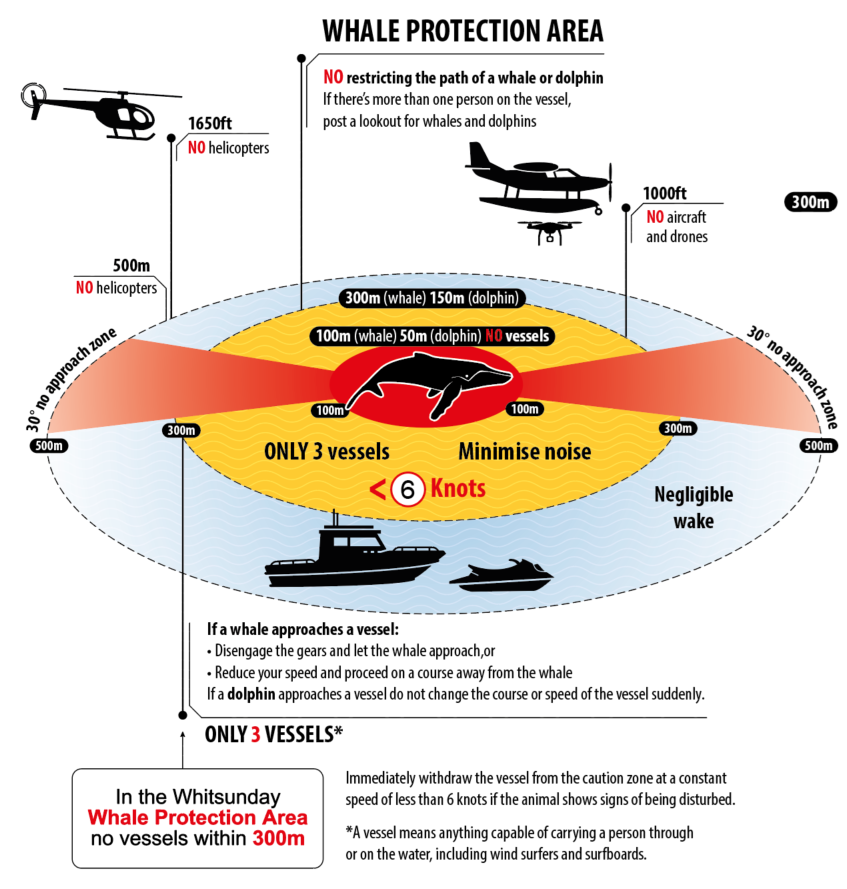
As someone who shares the waters with the Reef's precious cetaceans, you have a responsibility to help protect them and to keep safe distances (refer to the diagram below).
By following these responsible practices when you're near whales and dolphins, you play a big part in their conservation and provide a safe environment to watch them.
Report sick, injured, stranded or dead whales or dolphins. Also, report if your vessel accidentally strikes a whale.
- When boating around whales:
- Be alert and watch out for whales at all times, particularly during whale migration season (May to September)
- Post a lookout to keep an eye out for whales if they are suspected in the vicinity
- Do not approach or disturb mothers and calves – never place a boat between them
- Always move in a parallel direction to the whale or dolphin
- Do not use engine sound or speed to attempt to influence the behaviour of a whale
- When you're leaving an area where whales are present, turn the motor on, post a lookout, and move off slowly
- Slow down to minimise the risk of collision where whales have been sighted
- Report any boat strikes and reassure your passengers that the relevant authorities have been contacted to assist the whale.
- When boating around dolphins:
- Do not intentionally drive through a pod of dolphins to try to get them to bow-ride – some dolphins don't bow-ride and can become disturbed near boats
- If you encounter dolphins bow riding, maintain a constant speed and direction.
- When viewing whales and dolphins
- Never try to overtake whales or dolphins
- Avoid making sudden noise, speed or direction changes
- Be quiet when you are near a whale or dolphin
- Let the whale or dolphin control the situation – do not try to round up or herd
- Move away immediately if the whales or dolphins suddenly change their behaviour and appear agitated.
- Behaviours that indicate that boats should move away include:
- Bumping the vessel
- Rapid changes in swimming direction or speed
- Erratic behaviour
- Escape behaviour, such as prolonged deep dives
- Tail slapping or swishing.
- Marine Parks Legal Requirements:
- All whales and dolphins in the Great Barrier Reef Marine Park are legally protected
- Check the safe distances diagram (above) when operating a vessel or aircraft.
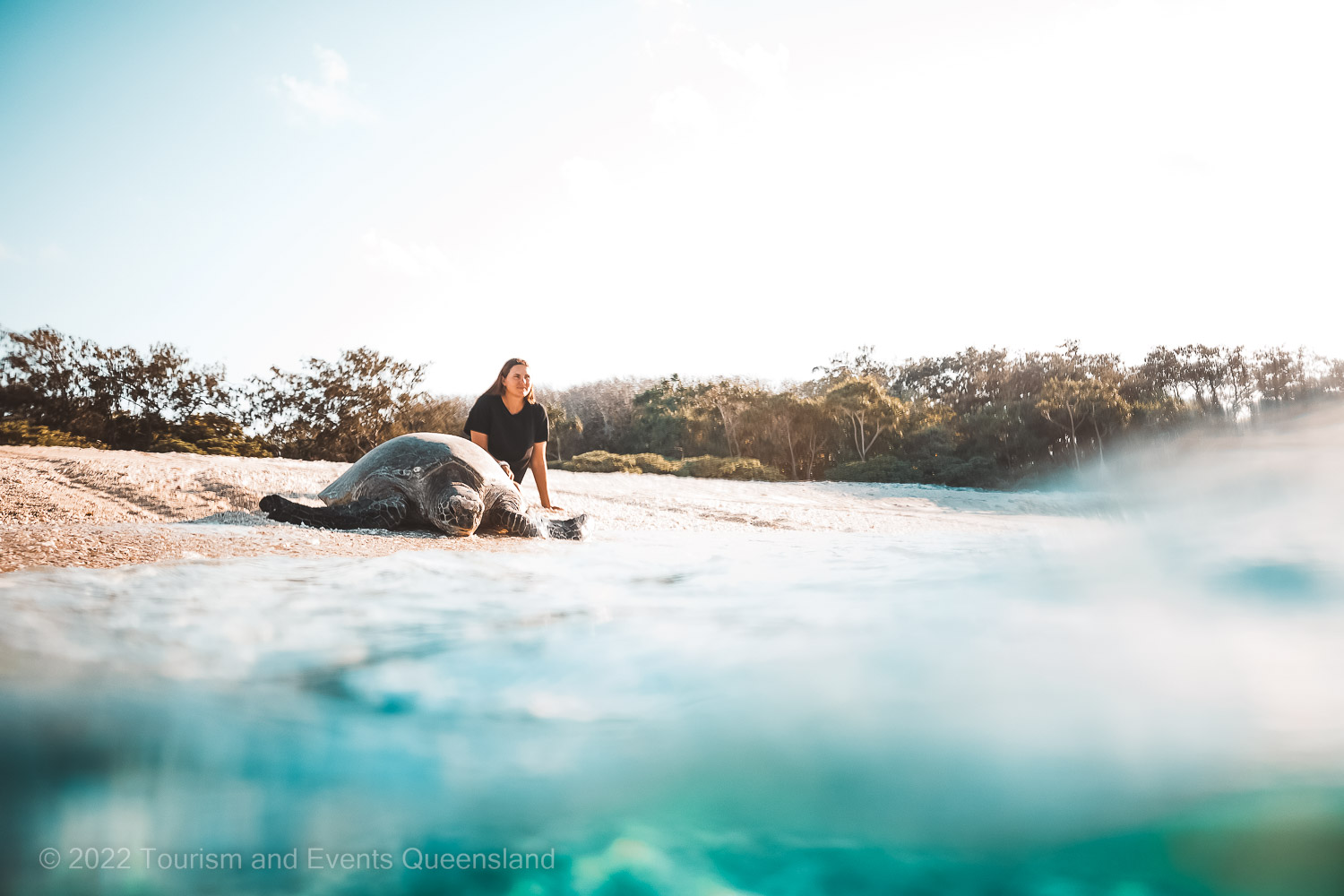
The Great Barrier Reef gives visitors some special opportunities to closely observe the life cycle of one of nature's most ancient and fascinating creatures, the marine turtle.
The Great Barrier Reef Marine Park is a critical foraging and nesting area to six of the world’s seven turtle species.
You must be particularly careful when boating in areas with turtle populations or when you’re watching turtle nesting.
- In general:
- Never touch, grab or lean on turtles, hatchlings or eggs
- Do not try to feed turtles
- Do not light campfires on turtle nesting beaches.
- When viewing from boats
- Be on the lookout for surfacing turtles in areas such as shallow reef flats and seagrass beds. Travel slowly in these areas, with no wake
- If a turtle is close to your vessel, engage neutral and allow the animal to move freely
- Do not encircle or trap turtles with vessels. Allow an escape route
- Do not drive your vessel over a turtle
- Do not pursue turtles if they try to avoid the vessel or flee the area.
- When viewing turtle nesting:
- Do not approach a turtle emerging from the water or moving up the beach
- On sighting a turtle emerging from the water, keep still and turn off all lights until laying begins
- Do not alter the environment in any way
- Limit the use of light by turning torches off whenever possible and viewing with ambient light. Turtles may get confused by artificial light and may not finish nesting
- Use low wattage torches (less than three-volt, two-cell) with red cellophane or a filter over the bulb
- Never shine lights directly onto turtles – angle the light towards the sand at the side of the turtle
- Stay well clear (at least two metres) of turtles nesting, covering their nest and moving up or down the beach – never stand in their pathway or make them alter their course
- Keep still and quiet – sudden movements will disturb turtles
- Remain behind turtles as they dig and lay their eggs – do not stand in front or where they can see you
- Restrict the use of flash photography to a minimum and only take flash photos during the egg laying phase. Always take these photos from behind the turtle
- Turn off all lights and do not use flash photography when the turtle is returning to the sea
- Remove lights and back away from the turtles if they appear stressed
- Watch where you step to avoid crushing eggs or hatchlings. Do not disturb or dig up nests.
- When viewing hatching:
- Stay well clear (at least two metres) of nests where hatchlings are emerging
- Limit the use of light and never shine lights directly onto hatchlings. Hatchlings may become confused by artificial light and may not make it to the ocean
- Use low wattage torches (less than three-volt, two-cell) with red cellophane or a filter over the bulb
- Do not shine torches out to sea when hatchlings are in the water – this may cause the hatchlings to return to shore
- Allow hatchlings to dig themselves out of the nest and run to the sea without disturbance or assistance
- Do not touch or handle hatchlings
- Never interfere with natural events (for example, rescuing hatchlings from seabirds or predatory fish).
- Marine Parks Legal Requirements:
- You must not ‘take’ turtles or their eggs in the Great Barrier Reef Marine Park unless you have a Marine Parks permit. Note: ‘Take’ includes removing, gathering, killing, interfering with, or attempting to take. There may be special arrangements for Traditional Owners.
The Great Barrier Reef offers visitors stunning vistas – both above and below the water, but it contains some very fragile environments. An act as simple as throwing an anchor overboard can impact the world below. Dropping an anchor on coral can take seconds to damage or destroy it. Under ideal circumstances, it may take years for the coral to rebuild, and in some cases, the coral may never return to its former glory.
By taking a little extra care when anchoring and using moorings where available, you will help protect this delicate underwater landscape.
- When anchoring:
- Use public moorings where available and do not anchor within no-anchoring areas – they are there to protect the coral.
- Where possible, anchor in sand or mud away from corals and other fragile marine environments. Suitable areas often show up as flat and smooth on your sounder.
- Anchor a safe distance from other boats and look out for people in the water when dropping your anchor. Never wrap anchor rope or chain around bommies or large coral heads.
- If anchoring ashore, carefully place the anchor to minimise damage.
- If anchoring overnight, anchor before nightfall and double-check the swing room.
- Carry enough chain and line for the depth you want to anchor in, and use only as much chain as you need to hold the vessel safely.
- Use your sand anchor and reef pick appropriately to minimise damage.
- Motor towards the anchor when hauling it in and retrieve the anchor when the line is vertical.
- If the anchor is caught on a reef, free it by hand wherever possible.
- Do not force the anchor free by motoring forward.
- Keep watch to make sure the anchor isn’t dragging.
- Rules for anchoring:
- You can generally anchor in most Great Barrier Reef Marine Park places. Please note there are rules around anchoring in specific places that you need to be aware of:
- You must not damage or remove coral.
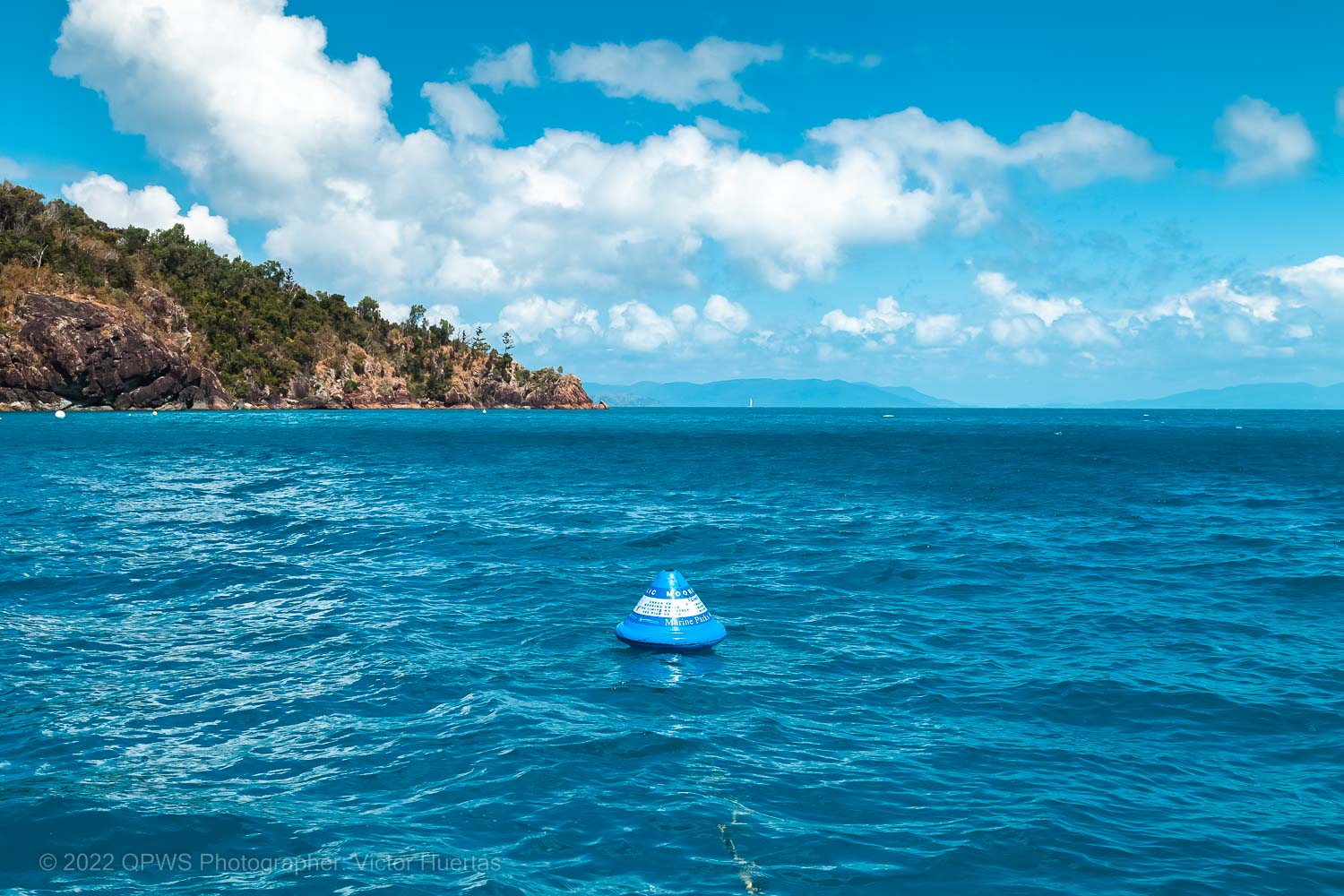
- You cannot anchor in designated no-anchoring areas generally marked with white pyramid-shaped buoys.
- Specific rules apply for anchoring in the Cairns, Hinchinbrook and Whitsunday Planning Areas:
- you must take reasonable care not to damage coral in the Cairns, Hinchinbrook and Whitsunday Planning Areas
- generally, you must not anchor within 50 metres of moorings and 200 metres of pontoons within the Cairns Planning Area
- in the Cairns Planning Area, vessels between 35 metres and 70 metres in length may anchor at a designated Reef Anchorage or designated anchorage or outside a Location. Vessels greater than 70 metres can only anchor at a designated anchorage or outside a Location
- in the Hinchinbrook Planning Area; vessels larger than 20 metres cannot operate in the Missionary Bay Location.
- in the Whitsunday Planning Area, vessels between 35 metres and less than 70 metres in length can anchor at a Setting 1 area, 21 superyacht anchorages, at 10 designated anchorages or outside a setting area. Vessels greater than 70 metres can anchor at a designated anchorage outside a setting.
The Great Barrier Reef is a nautical paradise, offering one of the most stunning environs in the world to go sailing or boating.
On the other hand, responsible practices are straightforward to follow and make good environmental sense and sound business procedures.
- In general:
- Be on the lookout for marine animals and travel slowly in areas where they are known to be present,
- For example:
- Humpback whales migrate along the Reef from May to September
- Dugongs inhabit shallow seagrass areas – particularly in the Hinchinbrook and Townsville regions
- Seabirds nest or roost on sand cays and islands
- Marine turtles are commonly found in shallow Reef and seagrass areas - especially during September and October when mating behaviour brings them close to the surface.
- Go slow near any islands and cays where seabirds are nesting or roosting
- Use the voluntary speed limits and transit lanes in the Hinchinbrook Area
- Look out for shallow coral or other environmental hazards, and consider tidal changes. Leave at least 30 centimetres clearance between the propeller and seabed
- Check for nesting seabirds or turtles before pulling your vessel onto the beach
- Slow down to minimise the wake when approaching reef edges, shorelines and beaches
- Avoid pulling your boat up onto delicate beach vegetation such as dunes
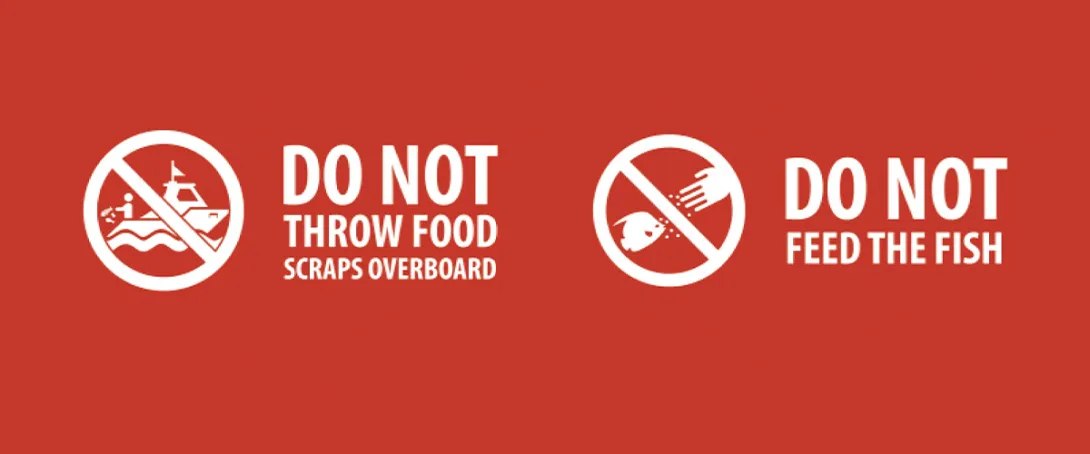
- Take all litter (for example, rubbish, food scraps and cigarette butts) with you and responsibly dispose of it onshore
- Collect debris that you find on and in the water and ashore
- Be considerate of others when motoring or anchoring near them. Match your activities to the setting around you
- Refuel onshore where possible, using the correct gear and have clean-up equipment ready.
- When cleaning your vessel:
- Do not carry out significant works at sea. Choose an approved slipway and maintenance facility, where possible. Contain any water used in the cleaning process that may be contaminated
- Do not clean or scrub hulls on or near reefs
- Use non-toxic, phosphate-free, chlorine-free cleaners (for example, baking soda, vinegar, citrus-based products, vegetable-based soaps). Avoid cleaners with bleach, ammonia, lye or petroleum distillates.
- Use cleaning and degreasing chemicals sparingly.
- Use non-toxic antifouling alternatives if practical (for example, silicon-based coatings, two-pack epoxy paint) or no antifouling.
- Wash your vessel down occasionally with a soft cloth to remove the slime layer and prevent the build-up of secondary fouling
- Inspect the hull of your vessel regularly - as well as the internal seawater pipe work, fenders, anchors, open bilges, propellers and sea chests - for marine growth.
- Report suspect species to the authorities
- If the vessel has remained stationary for an extended period, treat any internal seawater systems using a diluted (less than five per cent) detergent solution before departing port.
- When maintaining your engine:
- Keep your outboard engines in good condition, and fix all leaks immediately
- Inspect fuel lines for cracks and loose connections, and replace the lines before they start leaking
- Steam clean your engine rather than use degreasing chemicals whenever possible
- When refuelling:
- Refuel on shore wherever possible. Use the correct gear and have spill response equipment readily available
- Always fill portable fuel containers on shore
- Have fuel absorbent material on hand to catch spills
- Dispose of fuel-soaked cloth at a hazardous waste facility, not in the rubbish bin.
- Marine Parks Legal Requirements
- You must abide by the group size settings in the Cairns Planning Area
- You must abide by the vessel length and group size settings in the Hinchinbrook Planning Area. It would be best if you did not operate a vessel longer than 20 metres in Missionary Bay of the Hinchinbrook Planning Area unless using the transit lanes.
- You must abide by the vessel length and group size settings in the Whitsunday Planning Area.
- You must have a Marine Parks permit to conduct a commercial operation in the Great Barrier Reef Marine Park such as providing transport, accommodation or services for tourists.
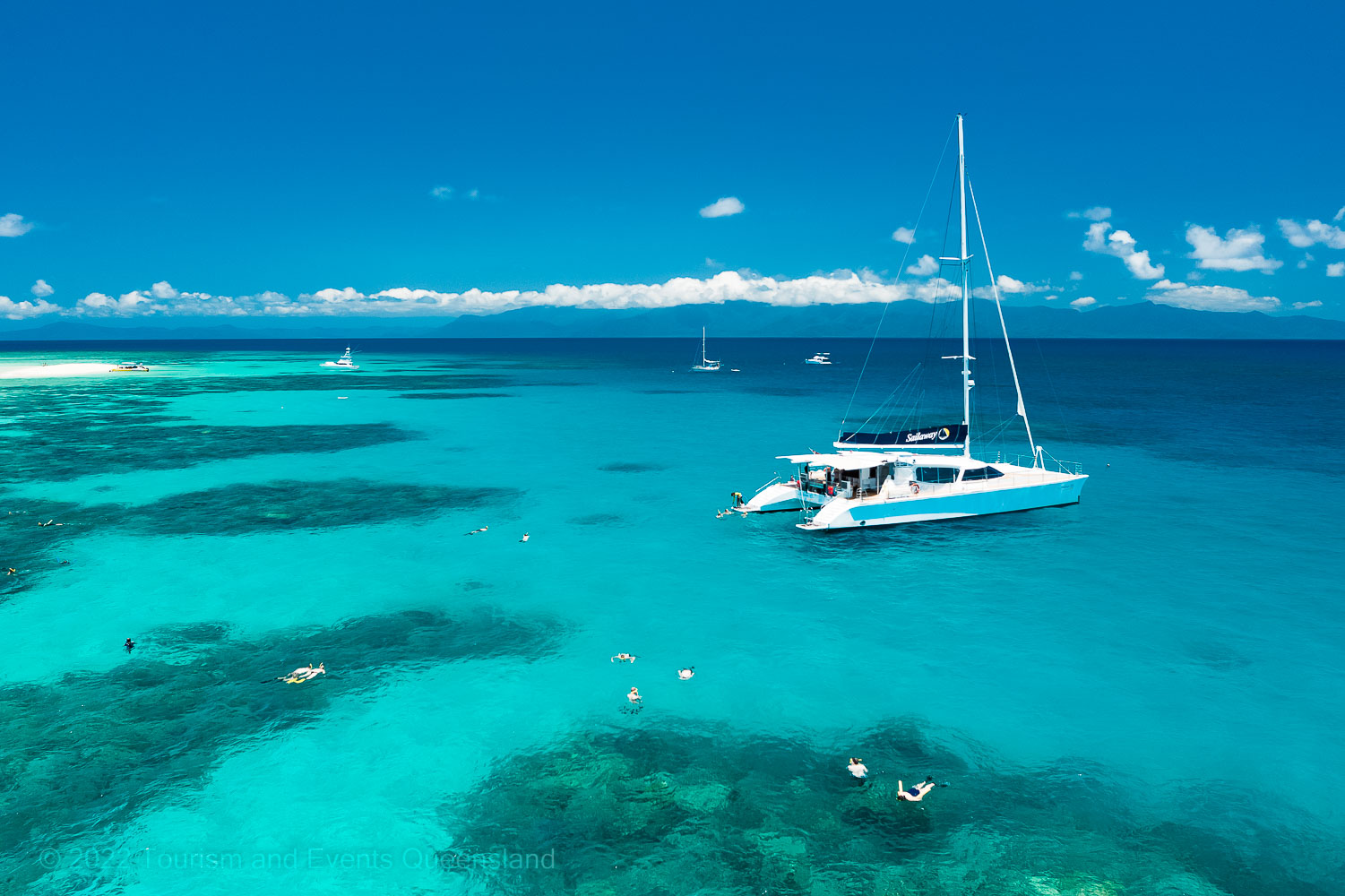
Every day, more and more people are getting out onto the waters of the Great Barrier Reef in private boats to enjoy a unique lifestyle of fishing, diving and sightseeing.
Many private vessels are powered by outboard engines. Unfortunately, the operation of these motors causes the discharge of a number of pollutants.
Many small engines, such as conventional two-stroke engines used in marine outboard and personal watercraft, are high polluters relative to their engine size and usage, emitting a range of toxins into the water and the air.
As substantial power is required to move small craft through water, even the better-performing engines can emit far greater quantities of pollutants per hour than typical modern car engines.
A comparison of a conventional 15-horsepower carburettor two-stroke outboard and a 150-horsepower fuel-injected four-stroke outboard found that the smaller engine produced three times the emissions of the larger engine.
- Responsible Reef Practices:
- Consider purchasing a new, cleaner-running marine engine
- Choose ultra-low emission engines and use the OEDA VELS as a guide (see table below)
- Ensure that your outboard motor is kept in good condition and serviced according to the manufacturer's recommendations
- Properly match engine horsepower to the size of your vessel
- Use the right size propeller and keep it in good condition (nicks and dents reduce performance)
- Drive your boat conservatively. Abrupt starts, excessive speed and extended use of full throttle not only reduce fuel efficiency and increase emissions but are also hazardous to slow-moving marine animals such as dugongs and turtle
- Learn to trim your boat whilst underway
- Reduce unnecessary engine idling
- Reduce weight. Extra cargo in your boat reduces fuel efficiency.
Outboard motor emissions ratings
To help boat owners choose outboard engines based on comparable emissions, Outboard Engine Distributors Australia (OEDA) has implemented an emissions rating system known as the Voluntary Emissions Labelling Scheme (VELS) for sales of new outboard engines, similar to energy and water efficiency rating schemes for household appliances.
- OEDA Australia Star Rating Star Rating Description OEDA Emissions Limit*
- Zero Star - High emission: Will be a handful of older design two-stroke engines - > 250
- One Star - Low emission: Most traditional two-stroke engines - 68.4 - 250
- Two Stars - Very low emission: Some two-stroke direct injection and four-stroke engines - 30 - 64.8
- Three Stars - Ultra-low emission: Most two-stroke direct injection and four-stroke engines - May 30
- Four Stars - Super ultra-low emission: For future technologies - < 5
* The OEDA Emissions Limits rate engines are based on Hydrocarbon (HC) and Oxides of Nitrogen (NOx) emissions, measured in grams per kilowatt per hour.
- When operating Motorcraft:
- Be considerate of other reef users in the area — be aware of your noise and wake.
- Stay a safe distance away from people in the water.
- Be on the lookout for marine animals such as dolphins, turtles and dugongs - reduce your speed and be especially alert in areas where these animals are known to occur.
- Go slow near islands and cays, especially where seabirds are nesting or roosting.
- Go slow near the coast, especially when you are near popular beaches.
- When travelling in shallow water, keep your watercraft at idle speed to minimise the stirring of sediments.
- Avoid beaching or anchoring in sensitive areas such as corals, seagrass beds, and nesting sites.
- When maintaining Motorcraft:
- Check that the engines do not leak fuel or oil.
- Conduct your vessel maintenance regularly (for example, spray paint, oil changes and engine cleaning) on land.
- Refuel on land, not on the water, to reduce the chance of spills.
- Fit a propeller cowl to protect wildlife.
- Marine Parks Legal Requirements:
- To protect wildlife and preserve a natural setting, there are some areas where motorised water sports may not be undertaken:
- You must not undertake motorised water sports in the Far Northern Management Area in the Remote Natural Area.
- You may only undertake motorised water sports outside Locations in the Cairns Planning Area. The boundary of a Location is generally defined as 500 metres from the reef edge.
- In the Hinchinbrook Planning Area, you may only undertake motorised water sports in Intensive Use Locations and outside Locations. Speed and access restrictions apply around Significant Bird Sites. In the Hinchinbrook Planning Area, a 'Location' boundary is generally defined as 500 metres from the reef edge.
- In the Whitsunday Planning Area, you may only undertake motorised water sports in setting 1 (intensive) areas, within a designated motorised water sports area and outside setting areas. In the Whitsunday Planning Area, the boundary of a 'setting' area is generally 1500 metres away from reefs or the coastline. Speed and access restrictions also apply around Significant Bird Sites.
- You must have a Marine Parks permit to undertake motorised water sports as part of a tourism program.
In the water
Diving and snorkelling are some of the best ways to take in the spectacular underwater views of the Great Barrier Reef and come face-to-face with its beautiful marine life.
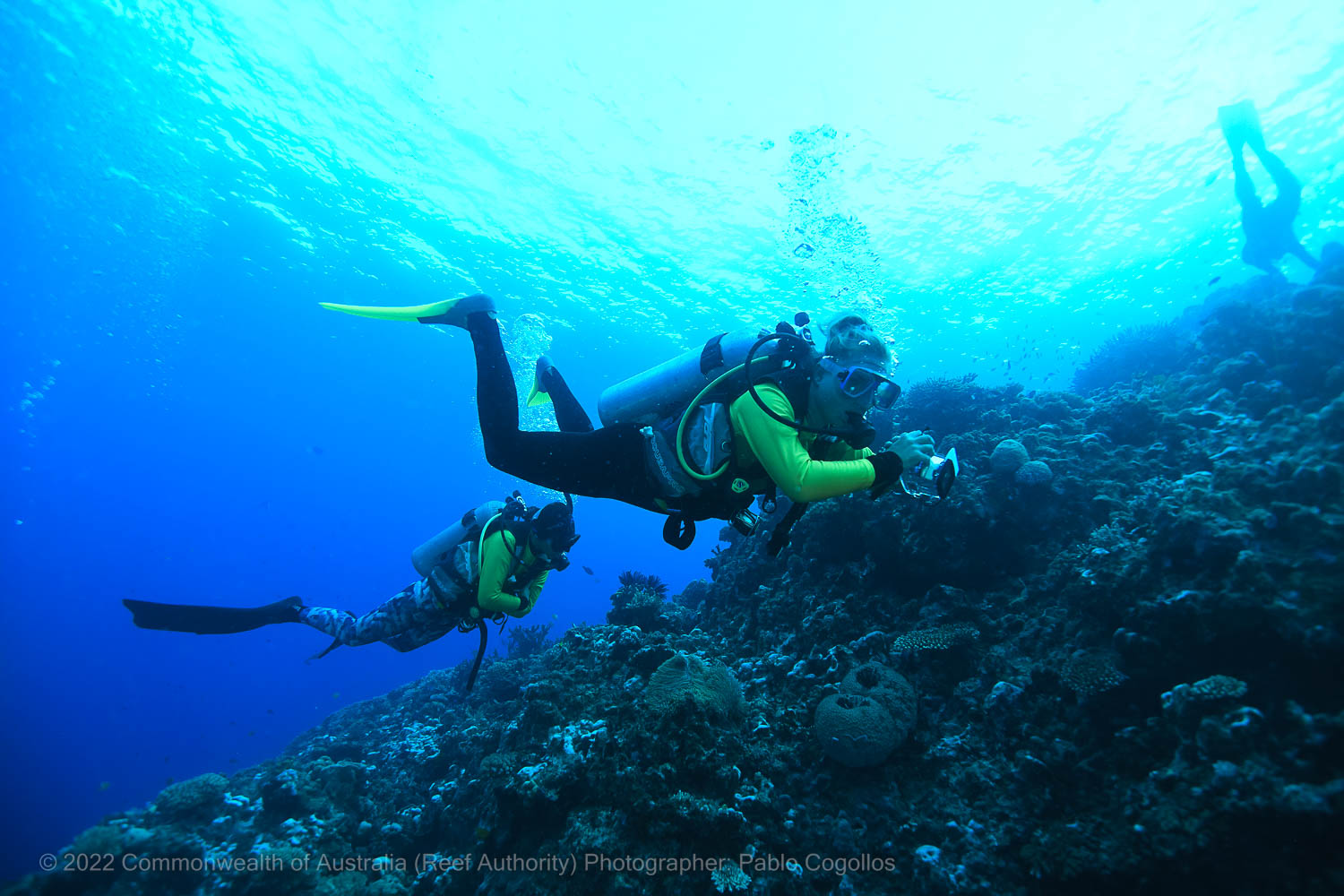
Most damage occurs due to those unable to maintain reasonable control in the water (for example, through fighting a current, trying to get a closer look, or taking photographs).
By having good snorkel and dive practices, you'll be able to preserve this extraordinary world for others to experience.
- In general:
- Wearing a wet suit or lycra suit when snorkelling or diving will help to protect you from the sunburn and stings from jellyfish
- Enhance the quality of your dive experience by learning about the environment you'll visit.
- Practice buoyancy control over sand patches before approaching a reef - test buoyancy whenever you're using new equipment such as new wetsuits, buoyancy control devices and cameras
- Make sure you are correctly weighted before diving near a reef
- Check that all your dive gear is secure before you get into the water so that it doesn't dangle and catch on the reef
- Move slowly and deliberately in the water, relax and take your time - avoid rapid changes in direction
- Avoid making sudden or loud noises underwater
- Avoid leaning on, holding onto or touching any part of the reef - this is particularly important when taking underwater photographs.
- Avoid kicking up and disturbing the sand if you're over a sandy area
- Avoid touching any animals or plants
- Avoid feeding fish
- Stay more than one metre away from giant clams
- Keep clear of free-swimming animals (such as turtles, whales and sea snakes). In particular, do not chase, ride, grab or block the path of these animals.
- Avoid relocating any marine life, particularly when taking photos and filming.
- Marine Park's legal requirements:
- You must not damage, collect or otherwise take coral, including dead coral and protected shell species (that is, giant triton shell, helmet shell and giant clam) in the Great Barrier Reef Marine Park unless you have a Marine Parks permit.
Note: Take includes removing, gathering, killing, interfering with, or attempting to take. There may be special arrangements for Traditional Owners.
On islands
The Great Barrier Reef gives visitors some special opportunities to closely observe the life cycle of one of nature's most ancient and fascinating creatures, the marine turtle.
The Great Barrier Reef Marine Park is a critical foraging and nesting area to six of the world’s seven turtle species.
You must be particularly careful when boating in areas with turtle populations or when you’re watching turtle nesting.
- In general:
- Never touch, grab or lean on turtles, hatchlings or eggs
- Do not try to feed turtles
- Do not light campfires on turtle nesting beaches.
- When viewing from boats
- Be on the lookout for surfacing turtles in areas such as shallow reef flats and seagrass beds. Travel slowly in these areas, with no wake
- If a turtle is close to your vessel, engage neutral and allow the animal to move freely
- Do not encircle or trap turtles with vessels. Allow an escape route
- Do not drive your vessel over a turtle
- Do not pursue turtles if they try to avoid the vessel or flee the area.
- When viewing turtle nesting:
- Do not approach a turtle emerging from the water or moving up the beach
- On sighting a turtle emerging from the water, keep still and turn off all lights until laying begins
- Do not alter the environment in any way
- Limit the use of light by turning torches off whenever possible and viewing with ambient light. Turtles may get confused by artificial light and may not finish nesting
- Use low wattage torches (less than three-volt, two-cell) with red cellophane or a filter over the bulb
- Never shine lights directly onto turtles – angle the light towards the sand at the side of the turtle
- Stay well clear (at least two metres) of turtles nesting, covering their nest and moving up or down the beach – never stand in their pathway or make them alter their course
- Keep still and quiet – sudden movements will disturb turtles
- Remain behind turtles as they dig and lay their eggs – do not stand in front or where they can see you
- Restrict the use of flash photography to a minimum and only take flash photos during the egg laying phase. Always take these photos from behind the turtle
- Turn off all lights and do not use flash photography when the turtle is returning to the sea
- Remove lights and back away from the turtles if they appear stressed
- Watch where you step to avoid crushing eggs or hatchlings. Do not disturb or dig up nests.
- When viewing hatching:
- Stay well clear (at least two metres) of nests where hatchlings are emerging
- Limit the use of light and never shine lights directly onto hatchlings. Hatchlings may become confused by artificial light and may not make it to the ocean
- Use low wattage torches (less than three-volt, two-cell) with red cellophane or a filter over the bulb
- Do not shine torches out to sea when hatchlings are in the water – this may cause the hatchlings to return to shore
- Allow hatchlings to dig themselves out of the nest and run to the sea without disturbance or assistance
- Do not touch or handle hatchlings
- Never interfere with natural events (for example, rescuing hatchlings from seabirds or predatory fish).
- Marine Parks Legal Requirements:
- You must not ‘take’ turtles or their eggs in the Great Barrier Reef Marine Park unless you have a Marine Parks permit. Note: ‘Take’ includes removing, gathering, killing, interfering with, or attempting to take. There may be special arrangements for Traditional Owners.
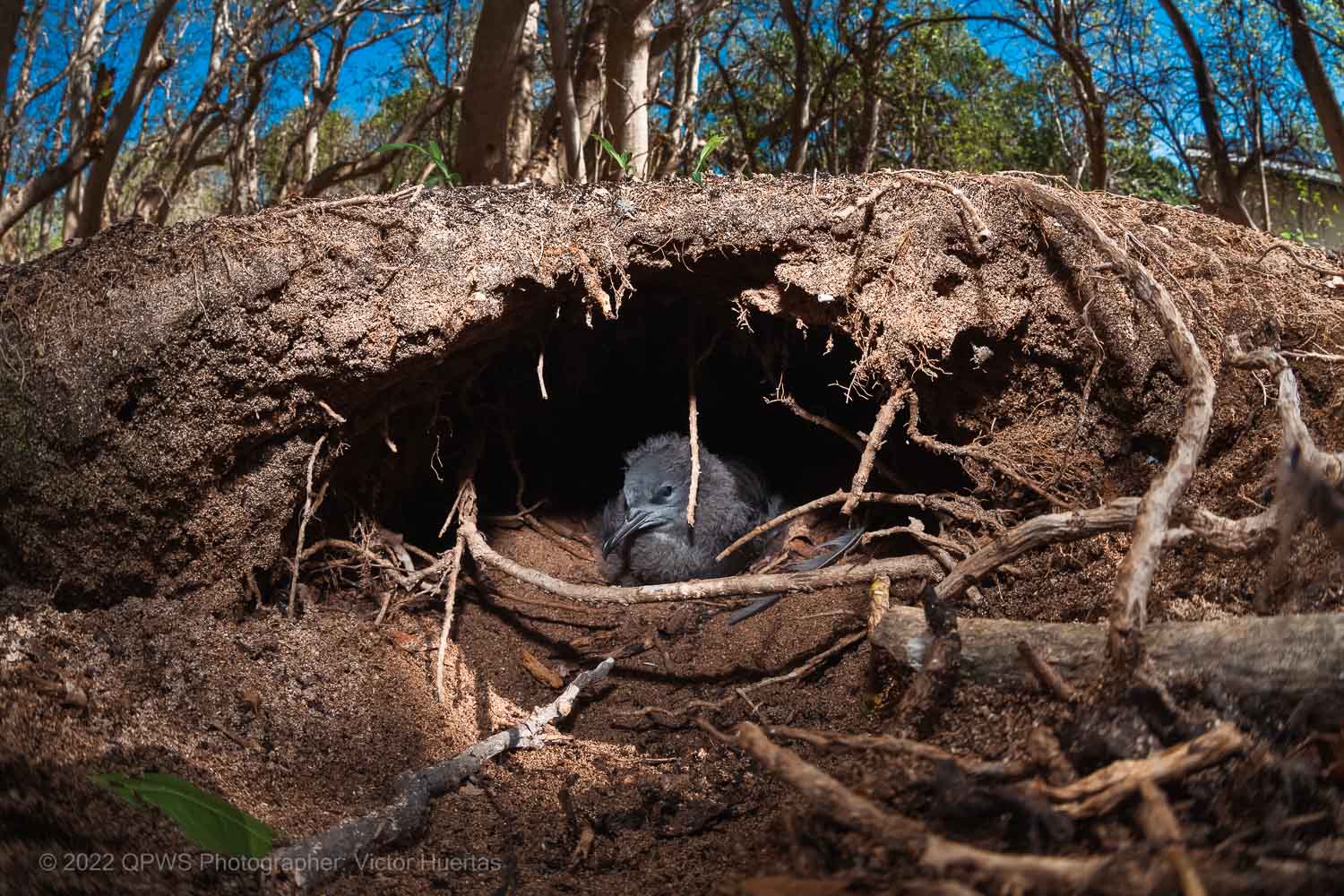
With an estimated 175 species, the Great Barrier Reef Marine Park boasts an incredible collection of birdlife – some are year-round residents, while thousands of others use the Marine Park as a much-needed pit stop during their exhausting annual migration.
Slight disturbances may scare the adult bird off the nest, and it can take only minutes for unattended eggs to be ruined or for chicks to be eaten by predatory birds.
- In general:
- Land and launch your boat well away from any seabirds or shorebirds
- Do not pull your dinghy up the beach into nesting areas
- Always try to not disturb any birds
- Stay well clear of nesting and roosting shorebirds and seabirds. Remain low by crouching, keep quiet, move slowly and use the existing cover
- Watch your step to avoid crushing camouflaged eggs and chicks
- Never try to touch birds, chicks or eggs
- Take particular care at the following sensitive times:
- Late afternoon and early evening
- The hottest part of the day
- Wet and/or cold weather
- Moonlit nights
- When eggs or naked/downy chicks are in their nests.
- If seabirds or shorebirds exhibit stressful behaviour (for example, raucous calling, swooping or ‘dive bombing’), back away and leave the area immediately
- Do not conduct activities that may disturb birds (for example, kite flying, volleyball, beach rugby, beach cricket)
- Do not use objects that flap or make noise (such as umbrellas or tarps) around nesting or roosting seabirds and shorebirds
- Do not sound horns, claxons, sirens or loudspeakers, and muffle the sound of your anchor chain
- Keep dogs well away from seabirds and shorebirds, ensure the dogs are kept quiet and on a leash, and avoid taking them to beaches where there often are seabirds
- Do not take animals (including dogs) to National Parks, islands or cays
- Do not shine torches or bright lights directly on roosting or nesting seabirds – angle the lights to the side and cover bulbs with red cellophane or filters.
- Marine Parks Legal Requirements:
- You must not 'take' birds or their eggs in the Great Barrier Reef Marine Park unless you have a Marine Parks permit. Note: 'Take' includes removing, gathering, killing or interfering with, or attempting to take. There may be special arrangements for Traditional Owners
- You must abide by access and speed restrictions at Sensitive Locations in the Cairns Planning Area, at significant bird sites in the Hinchinbrook Planning Area and at significant bird sites in the Whitsunday Planning Area
- You must not bring any animals (including dogs) to National Parks and most islands and cays.
Fishing
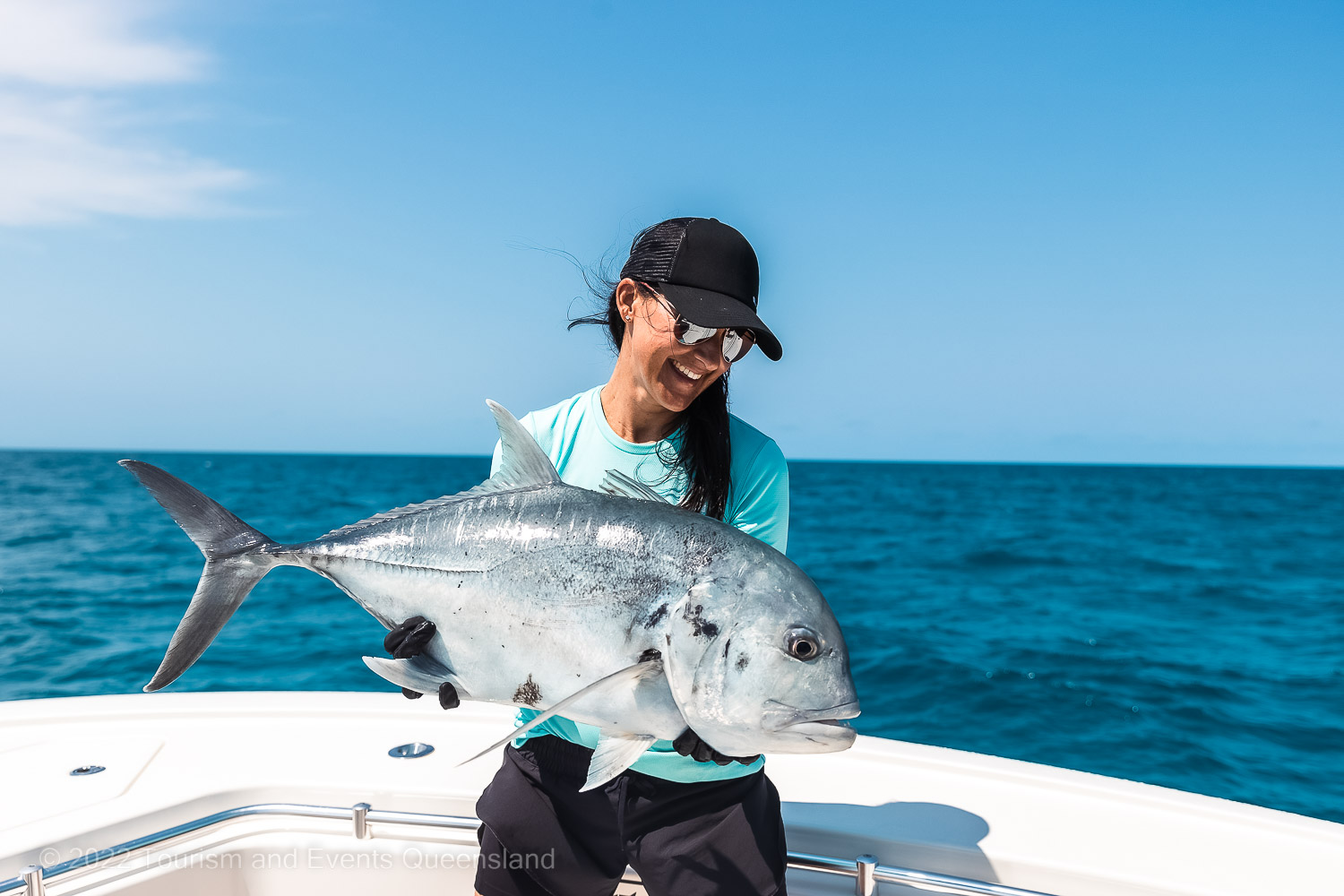
Fishing is a popular recreational pastime that allows people to spend time on the water with family and friends and to get in touch with nature.
In addition to observing fishing regulations, it is important that fishers adopt responsible fishing practices while out on the water.
By following these simple guidelines, you are helping to ensure that the Great Barrier Reef continues to be one of the best spots to fish.
Report tagged fish, suspected illegal fish kills (large numbers of dead fish), entrapped marine animals and suspected illegal fishing activity.
- Marine Park Zoning:
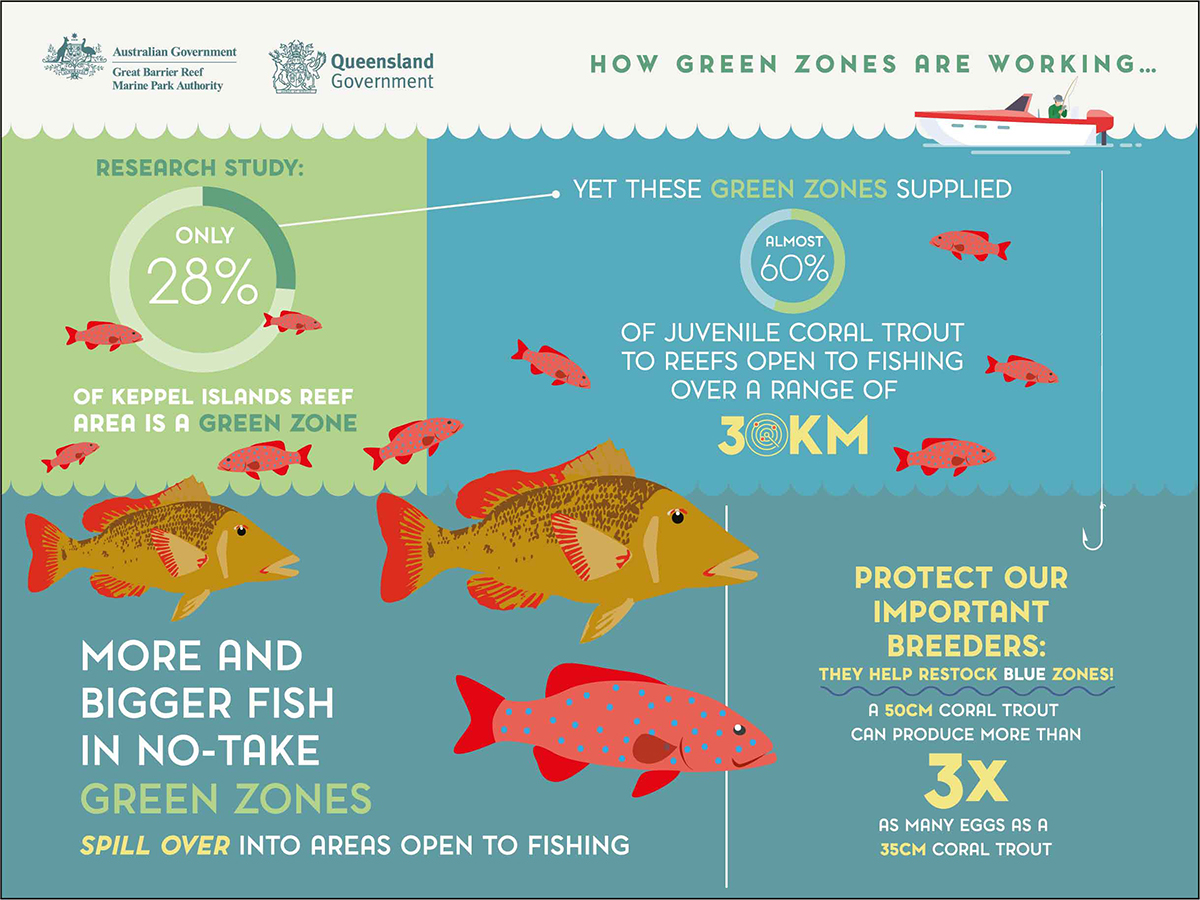
- Zoning helps to manage and protect the values of the Marine Park that people enjoy. Each zone has different rules for the activities that are allowed, the activities that are prohibited, and the activities that require a permit. Zones may also place restrictions on how some activities are conducted.
- Download this flyer to see how no-take zones work and provide various benefits.
- When fishing:
- Avoid anchoring on coral – anchor in sand, mud or rubble, and always avoid no-anchoring areas.
- Take only what you need.
- Do not use pests or non-native fish for bait. Never release introduced species into the water.
- Do not fish where fish feeding takes place, for example, as part of a tourist program.
- If you're unsure of the fish's identity or size, release the fish immediately.
- Return all under-sized and unwanted fish quickly to minimise injury
- If you're keeping the fish, kill it humanely and as soon as possible
- Do not litter - clean up all fishing gear (such as discarded tackle line and bait bags) and take it back to shore to dispose of properly.
Plant-eating fish remove seaweed that can proliferate after corals bleach — fishers and spearfishers should consider leaving these fish to help control seaweed and enable coral larvae to settle and create new colonies. Learn more about how herbivores can help the Reef recover from coral bleaching.
- When spearfishing:
- Always track down injured fish; do not let them swim off injured.
- Spear only what you need
- Do not pursue a fish if you are unsure of its identity or size
- Do not take big fish merely as trophies because these are important breeding stock
- Do not take plant-eating fish
- Herbivorous fish need you:
- This poster about herbivorous fish helps, and these videos of rabbitfish and unicornfish eating seaweed on the Reef help identify the fish.
- Herbivorous fish — Unicornfish
- Herbivorous fish — Rabbitfish
- Spearfishing in the Marine Park?
- The spearfishing factsheet shows you where you are allowed to spearfish in the Whitsundays.
- Going Spearfishing offshore Cooktown
- Going Spearfishing in the Cairns Region
- Going Spearfishing in the Whitsundays
- Going Spearfishing in the Keppels
- When returning unwanted fish:
- Minimise the length of time a fish is out of the water - keep fish in the water as much as possible and have your equipment close at hand. Very large fish should not be removed from the water
- Do not leave fish on a hot, dry surface to thrash around
- Place fish on a wet towel and cover them, especially the gills and eyes. The fish should not dry out, and direct sunlight can damage their eyesight.
- Handle fish gently - fully support its body; do not hold it upright by the jaw, squeeze or kneel on the fish.
- Use wet hands or wet cloth when handling fish to minimise damage to their protective mucous coating.
- Remove the hook carefully and quickly using a pair of long-nose pliers or a de-hooker to minimise tissue tearing. If the hook is difficult to remove, cut the line instead, particularly if the gut hooked.
- Help fish recover before release - gently release the fish headfirst into the water.
- Use barbless hooks or those unlikely to become hooked in the gills or gut, such as circle hooks.
- Where fish show signs of expanded swim bladder (barotrauma), return fish to deeper water using a release capsule, release weight, or vent with a hollow needle.
- Marine Parks Legal Requirements:
- You must not take or possess protected fish species in the Great Barrier Reef Marine Park unless you have a Marine Parks permit.
Note: Take includes removing, gathering, killing, interfering with, or attempting to take. Possess means to have custody or control of. There may be special arrangements for Traditional Owners.
- For many species that do not otherwise have possession limits, you can only take or possess up to five specimens at any time in the Great Barrier Reef Marine Park unless you have a Marine Parks permit
- You must abide by the fishing requirements in the Zoning Plan:
- General Use (Light Blue) Zone and Habitat Protection (Dark Blue) Zone - maximum of three lines/rods per person, six hooks in total
- Conservation Park (Yellow) Zone - one line/rod with one hook per person
- Buffer (Olive Green) Zone - maximum three lines/rods per person, six hooks in total, trolling for pelagic species only
- No fishing in the Scientific Research (Orange) Zone, Marine National Park (Dark Green) Zone or Preservation (Pink) Zone
- You must abide by Queensland Government (Department of Agriculture and Fisheries and Department of Environment and Science) fishing regulations, including species allowed, size limits, possession limits, protected species, tackle restrictions and seasonal and area closures.
- You must not discharge fresh fish parts unless the fish were caught in the Marine Park.