
Sea turtles are migrating to courtship areas across the Great Barrier Reef for their annual mating season.
Green, loggerhead and other marine turtles are gathering for marathon sexual encounters with multiple partners that can last for hours – and often days.
Reef Authority Director of Field Management Strategy Dr Mark Read said turtle courtship was highly competitive and sometimes aggressive.
- “Males use hook-like claws on their front flippers to grip the female’s shell,’' Dr Read said.
“Rival males may try to pile in, bite or pull them away for their own opportunity to mate."
Mating pairs of turtles must repeatedly return to the surface to breathe, making them vulnerable to shark attack and boat strike.
- “Mating is a particularly intense and risky time for turtles,” Dr Read said.
“They often move into shallow lagoons and reef areas for protection from large predators like sharks approaching from deeper water.
“It also exposes them to vessel strike, and we urge boaties to keep a good watch and to go slow for those below."
As the sex life of turtles is increasingly captured on camera and shared on social media, snorkellers are also advised to be cautious: male turtles can mistake people who get too close for female turtles.
Female turtles can mate with multiple partners and store sperm internally - effectively creating a biological sperm bank - to fertilise multiple clutches without mating again. A single clutch may contain more than 100 eggs and have several fathers.
A female’s reproductive life appears to be very long, as long-term tagging studies have demonstrated they can start breeding between 30 and 50 years old and continue breeding into their 70s or 80s. They typically wait several years between nesting seasons to rebuild their energy reserves. They can navigate vast distances using Earth’s geomagnetic field to return to the same region where they hatched.
Reef Authority officer Rachel Janes encountered a large female green turtle resting on Heron Island during a recent compliance patrol.
- “Females occasionally come ashore for a well-earned break from the persistent attention of males,” Ms Janes said.
"These ancient mariners have been doing this for more than 150 million years. The best thing we can do is let them be.”
Heron Island Resort Master Reef Guide Katie Tuesley said the annual mating spectacle between September and October was becoming increasingly visible around the island.
- “During mating season, you might spot a mating pair together at the surface,” Ms Tuesley said.
“If you’re lucky enough to see a turtle come ashore, stay well back, give her space and leave a clear path up the beach.”
While turtles get on with mating season, Reef Authority compliance patrols will continue across the Marine Park during the September school holidays, operating day and night, using patrol vessels, helicopters and drones.
Boaties should slow down around islands, shallow reef flats and seagrass meadows, keep a careful lookout, and make responsible Reef practices part of every trip.
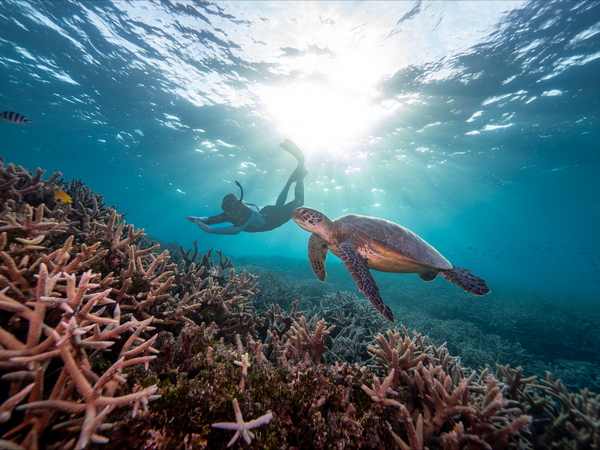
Top turtle tips
- Go slow for those below: Travel slowly with no wake around islands, reef flats and seagrass beds. Nominate a lookout and wear polarised sunglasses to reduce glare.
- Hands off: Never touch, grab or lean on turtles.
- Let her rest: Stay quiet, keep your distance and never block a turtle’s path or push it towards the water.
If you see a turtle that appears sick, injured, entangled or dead, report it to the free QWildlife app or call the Queensland Parks and Wildlife Service’s marine animal stranding hotline on 1300 130 372.
ENDS
For stills/vision/interviews click here: https://brandfolder.com/s/vfbjps442f475hwp6cnhz26
Contact: Great Barrier Reef Marine Park Authority
Media Hotline: (07) 4750 0846 | media@gbrmpa.gov.au